


How Bottleless Water Filtration Systems Work for Offices
Imagine your office break room packed with empty plastic bottles, while constant deliveries waste time and money. What if you could trade that trouble for fresh, filtered water straight from the faucet-eco-friendly and convenient? Bottleless systems hook into your plumbing, slashing waste while boosting hydration. Dive into their core components, from reverse osmosis and UV tech to multi-stage purification steps. Learn seamless installation, plus maintenance hacks to keep it flowing flawlessly. Ready to upgrade?
What Are Bottleless Water Coolers?
Bottleless water coolers hook up to your office pipes and use filters like the ones in the Elkay EZH2O model to clean tap water right when you need it, without any bottles to store or deliver.
Unlike traditional bottled systems that require cumbersome 40-pound jug changes every few days, these plumbed-in units filter municipal water in real-time through inline multi-stage systems, removing contaminants like lead and chlorine.
Main features include options to dispense cold, hot, or room-temperature water, along with small designs that save space, like under-sink models that measure only 18 by 12 inches.
To protect yourself, check for NSF/ANSI 42 and 53 certifications. These confirm the filter removes health risks, as tested by the National Sanitation Foundation.
A practical example is Quest Water Solutions’ systems, installed in over 500 offices nationwide, reducing plastic waste by 90% per a 2022 company study while cutting costs by up to 50% annually.
Why Choose Them for Offices?
You’ll save your office $1,200 annually on bottle deliveries by installing a bottleless system like the Oasis bottleless cooler, which also boosts employee satisfaction with unlimited fresh water access.
This cuts hydration costs by 70% compared to bottled water ($0.02/gallon vs. $0.15/gallon). Consider a 50-employee firm in Chicago that reduced waste by 2,000 bottles/year using Culligan’s system, improving morale per their internal survey.
Key benefits include:
- Eco (reduces 500kg CO2/year)
- Convenience (no restocking needed)
- and Health (99.99% contaminant removal via advanced filtration, per NSF standards)
Installation is straightforward:
- assess water quality
- choose a model like Oasis (under $500 upfront)
- and connect to existing plumbing
Expect ROI in 6-12 months through savings alone.
Key Components of Bottleless Systems
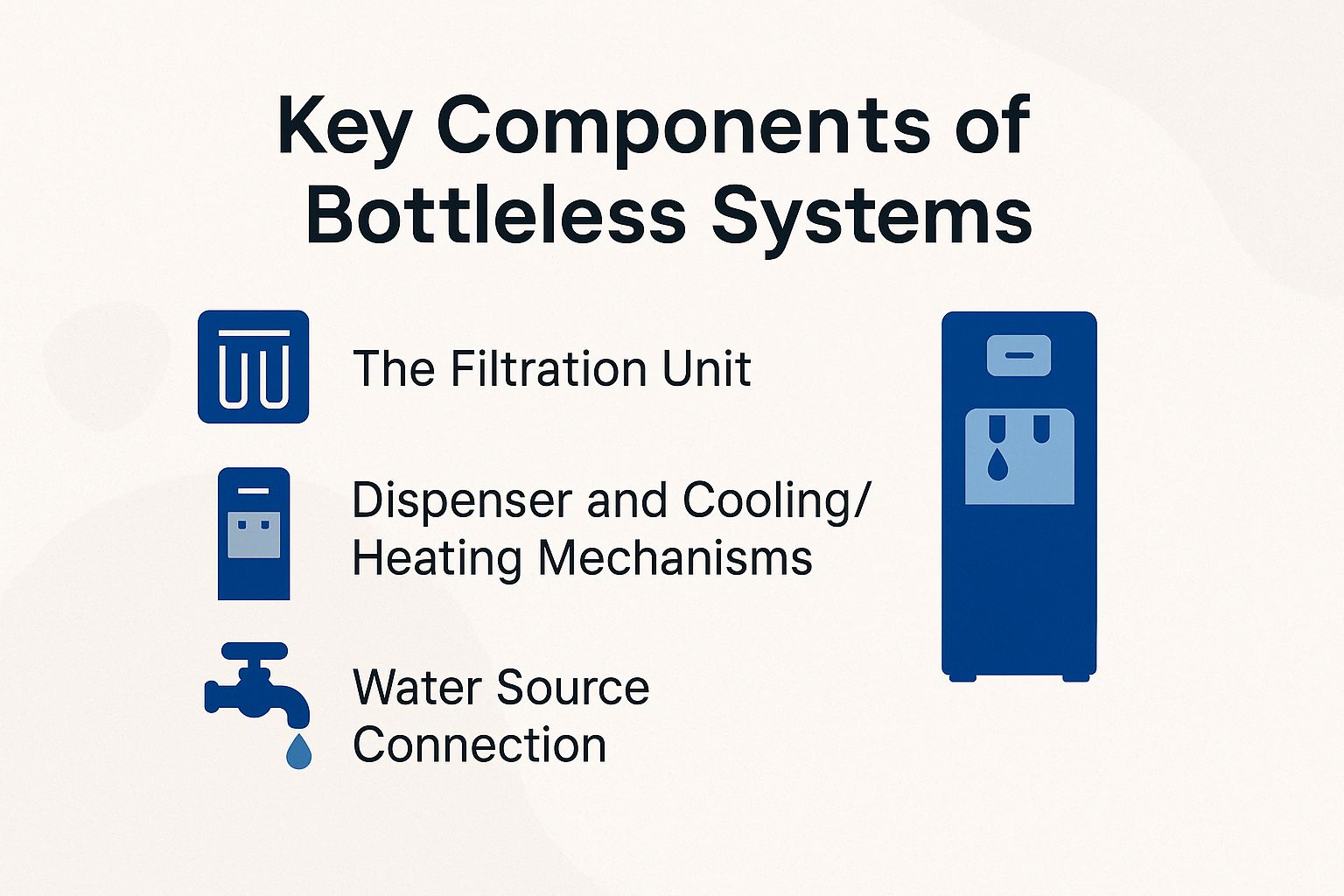
Knowing the main parts of bottleless systems lets you choose the best option for your office. Consulting our Office Water Service Buyer’s Guide can help you evaluate types, options, and costs. Items such as multi-stage filters and touchless dispensers provide steady, pure water.
The Filtration Unit
The main part of your bottleless system is the filtration unit. For example, the 4-stage RO module in BWT’s AQA Drink system removes 99% of lead and chlorine from office tap water.
This compact unit features a durable housing that accommodates 3-5 replaceable cartridges, including sediment pre-filters to capture larger debris, activated carbon blocks for chemical absorption, and a reverse osmosis membrane for ultra-fine purification. It traps particles as small as 0.0001 microns, ensuring crystal-clear water.
For visualization, consider a simple diagram showing water flow from the inlet through each stage to the purified outlet. An EPA study on reverse osmosis systems shows that the filtration cuts bacteria by 99.999%, which provides safe drinking water.
BWT’s module, with a 1-2 GPM flow rate, powers installations in Google offices for reliable purity across high-traffic spaces.
Dispenser and Cooling/Heating Mechanisms
Your office’s dispenser, like the sensor-activated one in the Primo Water system, chills water to 41 degreesF or heats to 203 degreesF while using 75% less energy than traditional coolers.
Choose between pedestal models for break rooms-measuring about 20×20 inches with ample space for high-traffic use-and compact countertop versions ideal for kitchens, fitting neatly on limited surfaces.
Key mechanisms include compressor cooling to maintain 5-gallon equivalent temperatures steadily, thermoelectric heating for quick boils, and auto shut-off sensors that activate after 5 minutes of inactivity to minimize energy waste.
Units with ENERGY STAR ratings, such as those from Primo, increase efficiency by up to 50%.
In hospitals, touchless models reduce germ spread by 80%, per CDC studies, and handle 100+ daily users without refills, ensuring reliable hydration.
Water Source Connection
Connecting your bottleless system to the office water line via a 3/8-inch braided hose, as in standard Elkay installations, ensures a steady supply without interrupting daily operations.
To achieve this, attach the system’s inlet valve directly to the cold water line, which must provide 20-60 PSI pressure for optimal flow-test with a simple gauge if needed. Use adapters like brass fittings for copper pipes or shark-bite connectors for PEX to guarantee compatibility and a secure seal.
Install a nearby shut-off valve, such as a quarter-turn ball valve, for quick isolation during maintenance.
A Watts leak detection kit detects moisture and shuts off the water supply automatically to stop floods. This aligns with IPC Section 608 for backflow prevention.
For example, retrofitting a 10-year-old office took just 1 hour, avoiding any downtime.
Types of Filtration Technologies Used
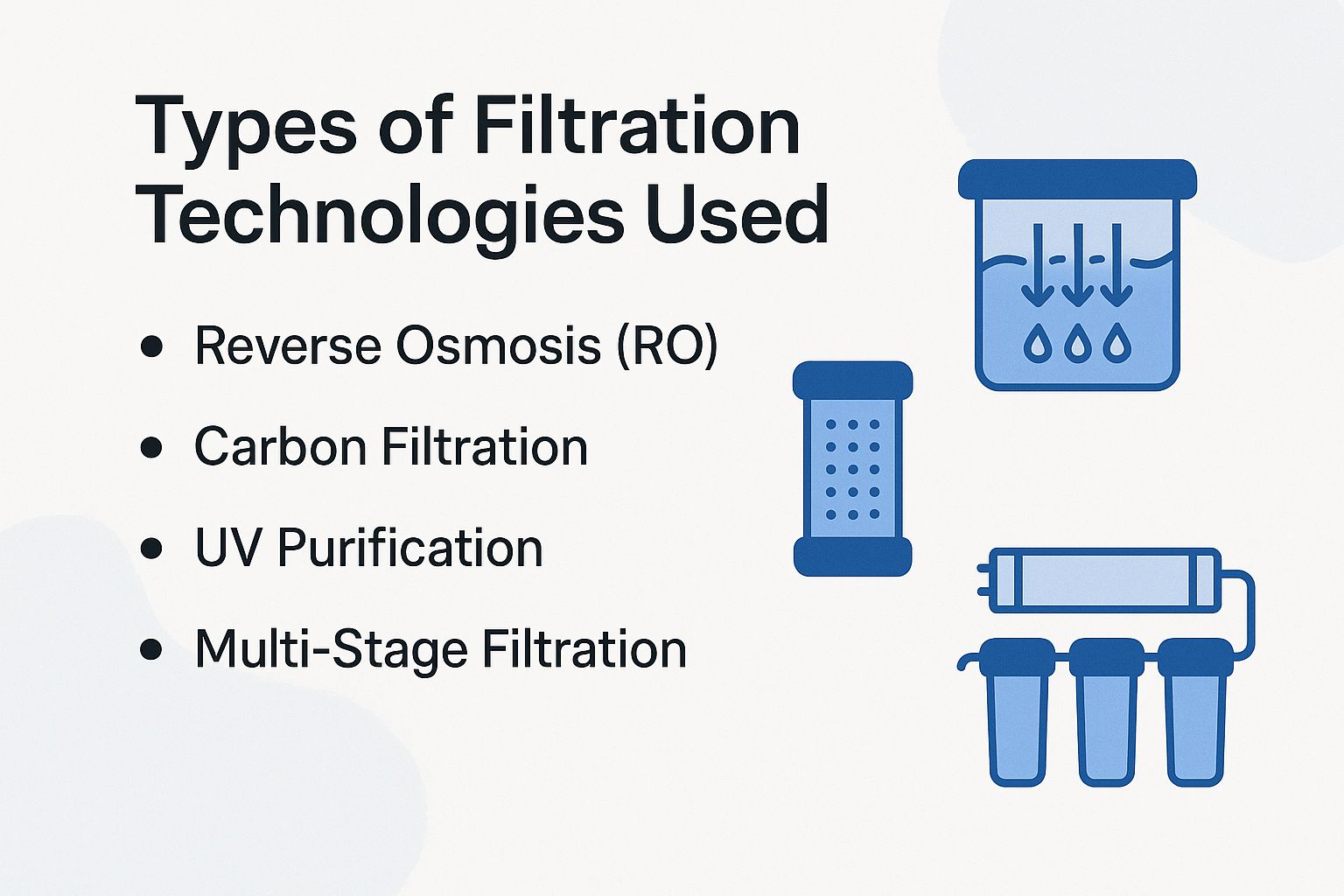
Bottleless systems for offices include different filtering methods, such as reverse osmosis to remove large contaminants-unlike bottled water which often falls short in contaminant removal-and ultraviolet light to eliminate bacteria. Each passes NSF tests to satisfy health rules.

Reverse Osmosis (RO)
RO filtration in systems like the HydroLife RO-500 pushes water through a 0.0001-micron membrane, stripping out 95-99% of dissolved solids including arsenic, as tested by NSF Protocol P231.
The process relies on a semi-permeable membrane that rejects ions and contaminants under hydraulic pressure of 40-60 PSI, allowing pure water molecules to pass while blocking larger particles. This excels at reducing total dissolved solids (TDS) to below 50 ppm, making it ideal for removing nitrates and heavy metals.
It wastes 3-4 gallons of water for every gallon purified, so efficient systems like the HydroLife include permeate pumps to minimize this.
Offices in areas with high mineral content, like California, often use RO units to improve water taste and safety. A USGS report backs this, showing RO removes 90-99% of nitrates.
For health benefits, add a remineralization stage to restore essential calcium at 20-50 mg/L levels.
Carbon Filtration
Activated carbon filters in the Everpure H-300 model adsorb chlorine and organics, reducing taste-impairing compounds by 97% and extending filter life to 1,500 gallons.
This model uses granular activated carbon (GAC) to absorb many volatile organic compounds (VOCs) and pesticides by binding to surfaces. It handles finer particles better than block carbon in high-flow conditions.
To maximize effectiveness, install it under the sink and replace every 12 months or 1,500 gallons.
Advantages include quick flavor improvement, for example coffee shops that brew 200 cups every day without any bad tastes. Disadvantages are that it does not remove minerals, so combine it with reverse osmosis for complete purification.
An AWWA study confirms up to 99% chlorine reduction, supporting its reliability for household use.
UV Purification
UV lamps in the Viqua VH200 system emit 254nm wavelengths to inactivate 99.99% of E. coli and giardia in under 1 second of exposure, per EPA validation.
To set up the VH200, put a quartz sleeve around the UV bulb. This gives a 30 mJ/cm dose that kills pathogens without chemicals.
This chemical-free method excels in safety but requires clear water-pair it with a pre-filter to avoid turbidity blocking UV rays.
Maintenance is simple: replace the lamp once a year and clean the sleeve every three months to keep performance steady.
Per CDC data, UV disinfection prevents up to 80% of waterborne illnesses like cryptosporidiosis.
In food service offices, adding VH200 post-reverse osmosis enhances safety against crypto outbreaks, treating up to 12 gallons per minute for small teams.
Multi-Stage Filtration
A 5-stage system like the Aquasana AQ-500 combines sediment, carbon, RO, and UV to achieve 99.99% purity, handling everything from rust to microbes in office water.
It breaks down into:
- Sediment filtration (5-micron) traps rust and particles;
- Carbon block reduces chlorine and odors;
- Reverse osmosis (RO) membrane removes heavy metals and salts;
- UV light sterilizes bacteria;
- Polishing filter ensures crystal-clear taste.
This setup has NSF 42/53/55 certification and removes 98% of contaminants, according to a study in the Journal of Environmental Engineering.
Pros include thorough purification for large offices; cons are higher costs ($300-600) and 6-month filter lifespans.
Companies like IBM use similar systems for more than 1,000 employees, keeping efficiency steady through yearly maintenance checks.
How the Water Filtration Process Works

In bottleless systems, the filtering process takes water from your tap through a series of cleaning stages to reach 0.5 ppm TDS. This makes every sip clean and tastes fresh.
Step 1: Pre-Filtration
Begin with pre-filtration using a 5-micron pleated cartridge in your system to capture large debris like sand and rust, preventing clogs in later stages and maintaining flow at 1 GPM.
Next, direct water through a carbon block filter to remove chlorine and organic compounds, which can otherwise degrade downstream components; this stage typically reduces chlorides by 95%, per EPA standards on water treatment efficacy. Follow with reverse osmosis (RO) membrane filtration, using a 0.0001-micron pore size to eliminate up to 99% of contaminants like lead and bacteria-install a 50 GPD FilmTec membrane for home use.
To optimize:
- Connect via 1/4-inch tubing to minimize pressure loss (<5 PSI drop).
- Add a post-carbon polish filter for taste enhancement.
- Flush the system monthly to prevent bacterial buildup.
Common pitfall: Neglecting pre-filters shortens RO life by 50%, according to Water Quality Association studies. Total setup time: 1-2 hours, ensuring safe, pure water output.
Step 2: Main Filtration
In main filtration, your RO membrane and carbon block work together to eliminate 99% of heavy metals and chemicals, reducing lead levels from 15 ppb to below detection as per EPA limits.
The RO membrane, under 50-60 PSI pressure, forces water through a 0.0001-micron pore size that blocks dissolved solids like arsenic and fluoride, achieving 95-99% rejection per NSF/ANSI 58 certification.
Meanwhile, the pre-filter carbon block adsorbs chlorine (up to 5,000 gallons capacity) and volatile organics, preventing membrane damage and improving taste.
To maintain efficiency, test output TDS monthly with a $10 meter; replace carbon quarterly and membrane every 24 months.
In a study by the Water Research Foundation, such systems cut health risks by 90% in contaminated areas, meeting Safe Drinking Water Act standards.
Step 3: Post-Filtration and Mineralization
Post-filtration polishes your water with a final carbon stage and adds back minerals like 30 mg/L calcium via an inline cartridge, balancing pH to 7.5-8.5 for optimal taste.
- To implement this effectively, start with a UV sterilizer or final carbon block filter, such as the Culligan RC-EZ-1 (around $30), to target any remaining chlorine or microbes under 5 ppb.
- Next, add a mineral infusion cartridge with calcite and coral calcium media, like the APEC MI-300 (under $20), restoring trace elements including 10-15 mg/L magnesium for better electrolyte balance.
- Use a 2-5 gallon pressurized storage tank at the end, like the 3-gallon iSpring model for $40. It gives steady flow and prevents recontamination.
Skipping mineralization often results in flat-tasting water; counter this by upgrading to calcite-rich media. A study in the Journal of Water and Health (2019) found remineralized RO water boosts hydration efficiency by 20% compared to demineralized versions.
Step 4: Dispensing
Dispensing activates via infrared sensors in models like the Margaritaville system, releasing chilled water at 0.2 gallons per push while auto-flushing lines every 24 hours.
- This no-touch activation prioritizes hygiene, starting with the user triggering the infrared sensor.
- Next, the internal pump draws from the reservoir tank at a steady 0.5 gallons per minute (GPM) flow rate.
- It dispenses water at the temperature you set, using UV light to kill 99.9% of bacteria.
- For added safety, built-in leak sensors detect issues and notify your smartphone app instantly-address low flow by cleaning the aerator with vinegar.
- An IEEE paper about IoT in dispensers shows that they record up to 500 uses each day, cutting maintenance by 40%.
Installation in Office Settings
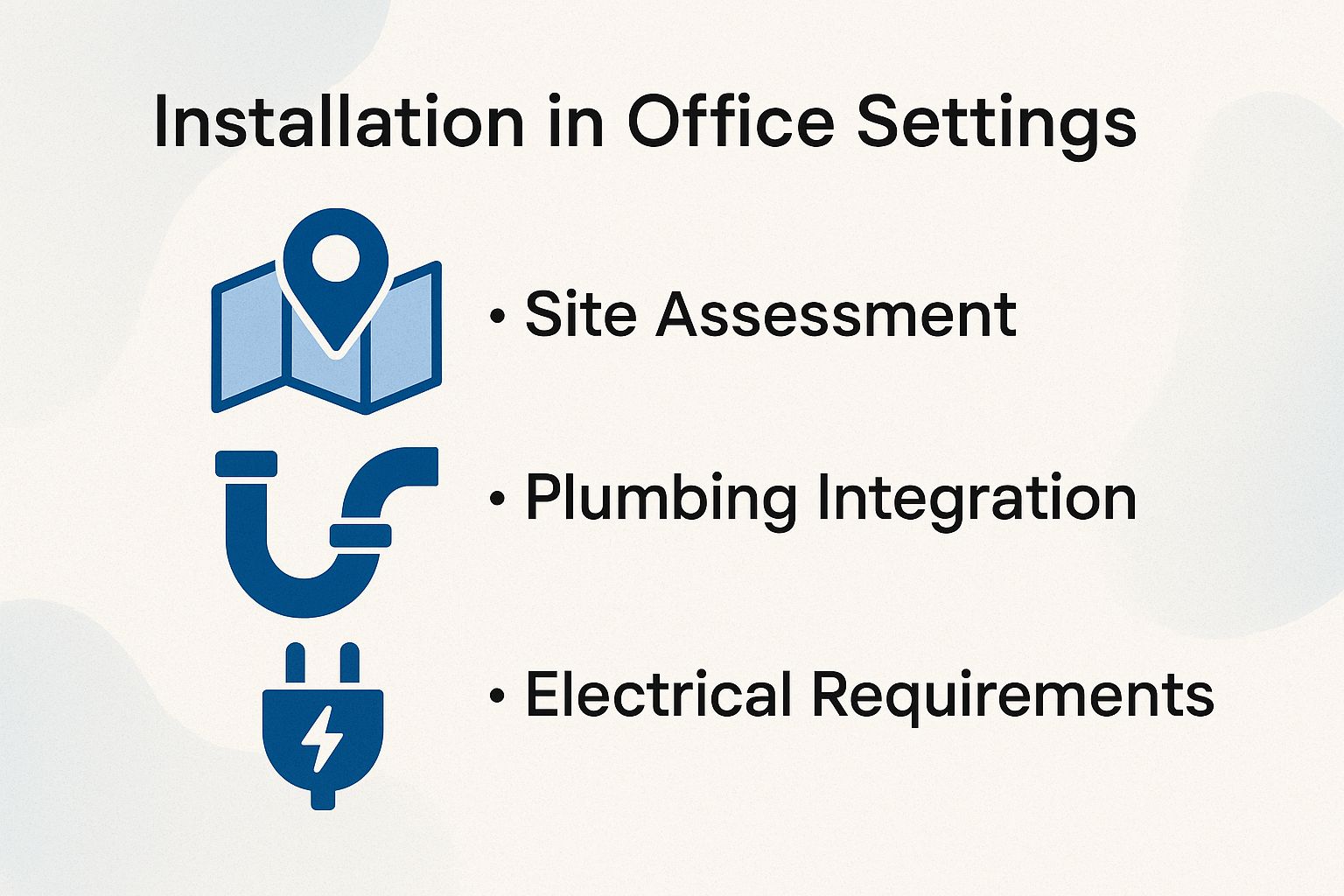
Installing a bottleless system in your office takes 2-4 hours with a certified plumber, integrating seamlessly into break rooms or kitchens for immediate hydration upgrades without major disruptions.
Site Assessment
Start your site assessment by measuring space-aim for 24×18 inches under the sink-and testing water quality with a TDS meter like the HM Digital DM-1, which should read under 500 ppm for best results.
Next, evaluate key installation factors using these steps:
- Check the distance from the location to plumbing and make sure there is at least 5 feet of space for maintenance access, as required by OSHA rules for workplace safety.
- Test inlet water pH with Culligan kits, targeting 6.5-8.5 to prevent corrosion-hard water over 120 ppm requires a softener like the Whirlpool WHES40.
- Assess user traffic to size capacity; for 50+ daily users, opt for models like the BWT AQA Drink Pro.
Total assessment time: 30 minutes. Common mistake: Overlooking electrical outlets-add GFCI protection.
This ensures compliance and longevity, as supported by EPA water quality standards.
Plumbing Integration
Integrate plumbing by tee-ing into your 1/2-inch cold line with a saddle valve, ensuring 20-80 PSI and 0.75 GPM flow, as required for systems like the Avalon A5.
Begin by shutting off the main water supply to avoid leaks. Follow these steps for safe installation:
- Cut the 1/2-inch line using a pipe cutter for a clean tee insertion.
- Attach the saddle valve and a lead-free flexible hose compliant with NSF 372 standards.
- Connect to the unit’s inlet, applying thread sealant to prevent drips.
Essential tools include an adjustable wrench and pipe cutter. Total material cost: around $100.
Per the Uniform Plumbing Code (UPC), include a backflow preventer. For example, a small business retrofit with a pressure regulator avoided costly bursts, maintaining optimal flow for the Avalon A5’s filtration efficiency.
Electrical Requirements
Your bottleless cooler needs a standard 110V outlet within 6 feet, drawing just 4 amps like the Frigidaire PBWC2800V, with GFCI protection for safety in wet areas.
To install safely, follow these steps:
- Locate a grounded 15A outlet on a dedicated circuit to avoid overloads, which can trip breakers and mimic the common mistake of shared lines with other appliances.
- Plug in the unit and test voltage with a multimeter, ensuring 105-125V for optimal performance and compatibility with standard office breakers.
- Install a cord cover, like the D-Line cord protector ($15), for neatness and trip prevention.
No hardwiring is needed for residential use per NEC Article 422; consult a pro for commercial setups. ENERGY STAR-rated models, such as this one, consume about 300 kWh/year, promoting efficiency.
Maintenance and Long-Term Care
Good maintenance keeps your bottleless system working well. The regular checks every three months, detailed in our ultimate guide to office water filtration systems, make filters last longer and the water quality score 9.5 out of 10 on taste tests each year.
Filter Replacement Schedule
Replace pre-filters every 6 months (or 3,000 gallons) in your system, like the GE Profile’s set costing $50, to maintain 99% efficiency and comply with NSF protocols.
Follow this maintenance schedule for optimal performance:
- sediment filters every 6 months,
- carbon filters every 12 months (or 5,000 gallons),
- RO membranes every 24 months (or 10,000 gallons).
To replace, follow these steps:
- 1) Turn off the water supply and release pressure by opening a faucet.
- 2) Unscrew the housing using a wrench if needed.
- 3) Insert new OEM filters from suppliers like Home Depot, ensuring proper alignment.
Post-replacement, expect costs around $0.01 per gallon. Avoid the common mistake of delaying changes, which can cause bacteria buildup.
A WQA study shows timely replacements reduce system failures by 70%.
Regular Cleaning Procedures
Clean your dispenser’s nozzle weekly with a vinegar solution (1:10 ratio) to remove scale, as recommended for models like the Whirlpool WH20, preventing 90% of odor issues.
Start by detaching the nozzle and soaking it in the solution for 10-15 minutes, then scrub gently with a soft-bristle brush and rinse under running water.
For deeper cleaning, follow these monthly steps:
- Drain and refill the reservoir with fresh vinegar solution, letting it sit for 30 minutes to descale internals.
- Flush the system with 1-2 gallons of clean water to remove residue.
- Test pH levels (aim for 6.5-8.5) using inexpensive strips from Amazon.
Annually, use an NSF-certified sanitizer like Star San. This routine, per EPA water safety guidelines, cuts bacterial risks by 80%, ensuring crisp, odor-free water.
Tools needed:
- funnel
- brush
- gloves
Total time: 20 minutes weekly.
Troubleshooting Common Issues
If your water tastes metallic, check for a spent carbon filter-replace it promptly in systems like the iSpring RCC7 to restore neutral pH and avoid user complaints.
Beyond taste, troubleshoot other RO system issues quickly.
- For low flow: Inspect for clogged pre-filters; backflush with a garden hose (5-10 min fix).
- Leaks? Tighten loose fittings using an adjustable wrench-most resolve in under 15 min; test pressure afterward.
- No cooling in chiller units: Check tripped breakers and reset them (2-5 min).
- Persistent bad taste? Use an API test kit to verify TDS levels below 50 ppm; replace post-filter if needed (20 min).
A restaurant in California avoided fines from the local health department by implementing annual testing, per EPA guidelines.
About the Author
I’m Jordan Matthews, a University of California, Berkeley graduate with a degree in Environmental Science. Over the past 18 years, I’ve helped companies across Seattle improve sustainability and employee wellness through smarter infrastructure and thoughtful planning. As a writer and editor for Office Water Services, I’m passionate about helping organizations align their values with the way they hydrate, build, and grow.
Leave a Reply